
Brian Jacobs, LPC
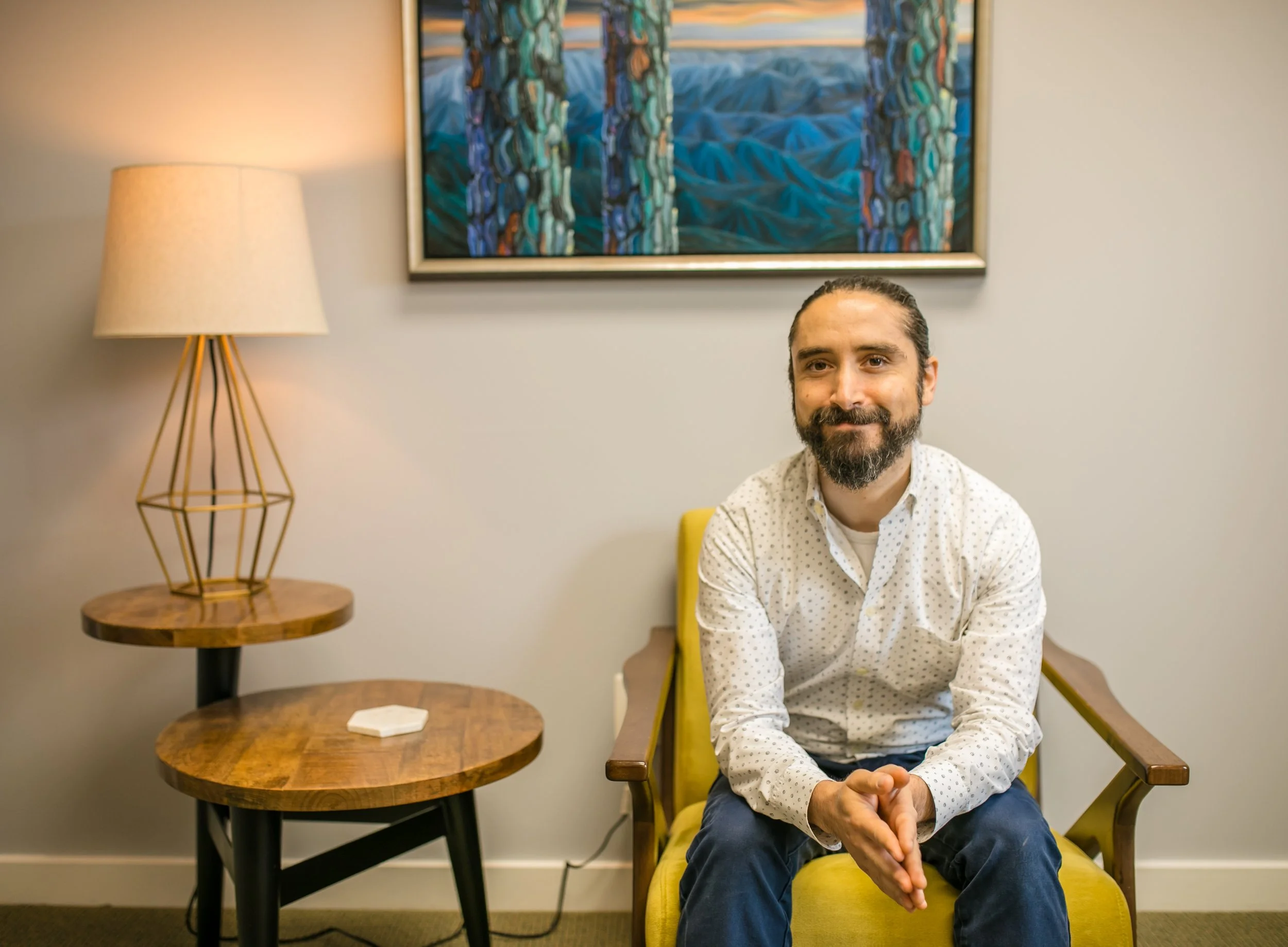
I remember being a kid and discovering there was such a thing as a therapist. You can talk to a professional about what's bothering you? Is this for real? How do I sign up—and can I become one? It made sense. I was highly attuned to emotions, fascinated by the mind, and already wondering about the hard stuff—why people suffer, what it all means.
Ironically, when it came time to choose a professional path, I resisted the call. It had been with me for so long that I didn't completely trust it. It felt too obvious, too easy. Surely I was supposed to explore other paths first. What else was out there? What was I missing? I took some odd left turns, but eventually, like most travelers, I found I could no longer resist the call.
Best decision I ever made. Helping people through the painful stuff—the really, really painful stuff—is where I'm at my best and most fulfilled. I don't shy away from hurt or suffering; I never have. In fact, it's what I most want to understand in this world. There are many ways to help others, and this is my way.
HOW I WORK
My approach is straightforward: I'm interested in why you're struggling, not just how to help you manage the struggle better. Coping strategies have their place, but real change happens when we address what's actually driving the patterns that keep you stuck.
I work primarily with EMDR, AEDP, ISTDP, and Internal Family Systems (IFS)—all evidence-based approaches designed to get at root causes rather than surface symptoms. EMDR helps reprocess traumatic memories so they stop hijacking your present. AEDP and ISTDP focus on the defensive patterns (avoidance, intellectualization, people-pleasing) that keep you from feeling what needs to be felt. IFS helps you understand the different "parts" of yourself—the inner critic, the perfectionist, the protector—and how they're trying (unsuccessfully) to keep you safe.
These aren't separate techniques I rotate through. They work together. We identify the protective patterns keeping you stuck—maybe it's overthinking, self-sabotage, perfectionism, compulsive behaviors—and trace them back to the pain they're protecting you from. Then we do the work of healing that pain, not just managing it.
This is depth work. It's not always comfortable, but it's often transformative. And it integrates what Western neuroscience has figured out about how the brain processes trauma with what Eastern philosophies have known for centuries about awareness, compassion, and being present with what is.
SUPPORT AND CHALLENGE
Good therapy requires both empathy and honesty. If I'm only validating and supporting you, I'm not doing my job. Part of my role is to help you see the patterns that aren't working, or how you might be getting in your own way, even when those patterns feel protective or automatic.
This isn't about looking for flaws. It's about helping you understand why you do what you do, so you can make different choices when you're ready. I'll support you through the hard stuff, but I'll also challenge you when that's what's needed. Real growth happens in that balance.
RESEARCH
In addition to my private practice, I work as a research therapist on clinical trials exploring psychedelic-assisted therapies. This keeps me at the forefront of emerging treatments and deepens my understanding of how non-ordinary states of consciousness can facilitate healing in ways traditional talk therapy sometimes can't reach.
The clinical trial work informs my practice, and my practice informs how I think about the research. It's a two-way street that keeps me grounded in both evidence and real-world application.
SPECIALIZED TRAINING








EMDR (Thrive Training & Publications)
IFS Informed EMDR (Syzygy Institute)
ISTDP (Washington School of Psychiatry)
MDMA-Assisted Therapy (MAPS)
Psychedelic Harm Reduction & Integration (Fluence)
Trauma Focused-CBT (TF-CBT Certification Program)
EDUCATION
M.Ed. Clinical Mental Health Counseling (George Mason University)
The work looks different depending on what brings you here. You can read more about how I approach trauma therapy, OCD treatment, anxiety therapy, depression therapy, EMDR therapy, and psychedelic integration.
If what you've read here feels like the right fit, reach out. We can start with a conversation about what you're dealing with and whether depth work makes sense for you.